


4 Security for Multi-Agent Systems and Live Search
AI Agents Now Search the Live Web and Delegate Tasks: 4 Security Boundaries to Set First
When an autonomous pipeline pulls unvetted external data into production systems while orchestrating downstream processes, system security can no longer depend solely on model safety alignments. The primary challenge shifts from model intelligence to structural governance: defining precisely what data an agent can view, which system actions it may initiate, and how every autonomous decision is verifiably logged. Establishing granular system perimeters before scaling deployment is crucial for long-term operational resilience.

1. Source Control: Real-Time Web Search as an Untrusted Ingestion Layer
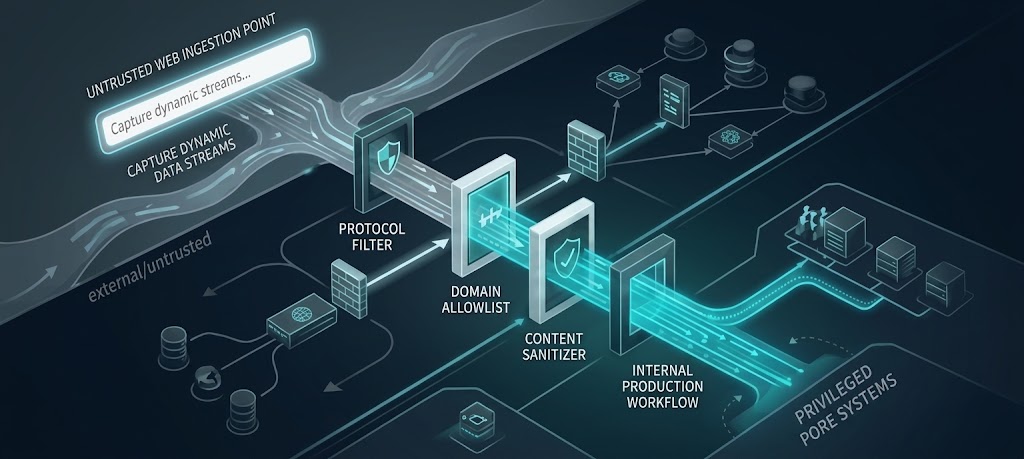
Managed capabilities such as cloud-native search tools ground agent reasoning in up-to-date, cited web content. Although live grounding eliminates outdated hallucinations, it simultaneously creates an untrusted input vector during runtime execution. In isolated research tasks, pulling web content carries low systemic risk; however, when the same autonomous execution pipeline connects to internal knowledge repositories, customer relationship records, or elevated API tokens, vulnerabilities escalate rapidly.
A malicious external webpage containing prompt injection payloads can manipulate an agent's reasoning path. If that compromised reasoning triggers an automated internal operation, the enterprise faces tangible data leakage or operational disruption. Organizations must define clear engineering policies in writing before activating search integration:
- Domain Allowlisting and Filtering: Which trusted domains and protocols are authorized for runtime queries, and which external origins remain blocked by default?
- Ingestion Lifecycles: How long is external web content cached within the execution pipeline, and how is tainted context invalidated?
- Downstream Content Sanitization: Can raw external web text be passed directly into downstream enterprise databases or end-user communications without prior inspection?
- Retrieval Telemetry: Are runtime queries, returned payloads, and parsing logs recorded in full to enable rapid root-cause audits?
Treat every search response as unvalidated user input. If an autonomous system cannot verifiably demonstrate how external web content is parsed and sanitized before reaching action tools, the workflow remains vulnerable to indirect prompt injection and data exfiltration.
2. Trust Mapping for Multi-Agent Orchestration Networks
Modern development frameworks provide standardized libraries for orchestrating multi-agent interactions across heterogeneous programming languages. As sub-agent coordination simplifies technically, the trust model must become explicit. The moment an orchestrator agent delegates a operational goal to specialized sub-agents, system security expands beyond a single system prompt into a distributed microservice topology where each node carries unique privileges, contextual access, and systemic failure profiles.
Engineering leaders should build a comprehensive trust map prior to multi-agent deployment. For every connected agent in the network, technical documentation must define:
- Tool Permissions and Credentials: Which external endpoints and execution functions can the agent invoke, and are service credentials strictly scoped to the agent's distinct domain?
- Contextual Scoping: What specific database schemas or internal documents are visible to the agent, and which sensitive attributes must be stripped before ingestion?
- Network Boundaries: Is the agent restricted to internal read actions, or is it allowed to make outbound network calls to external endpoints?
- Execution Authority: Can the agent commit state-changing tasks directly, or is its capability restricted to compiling drafts for human verification?
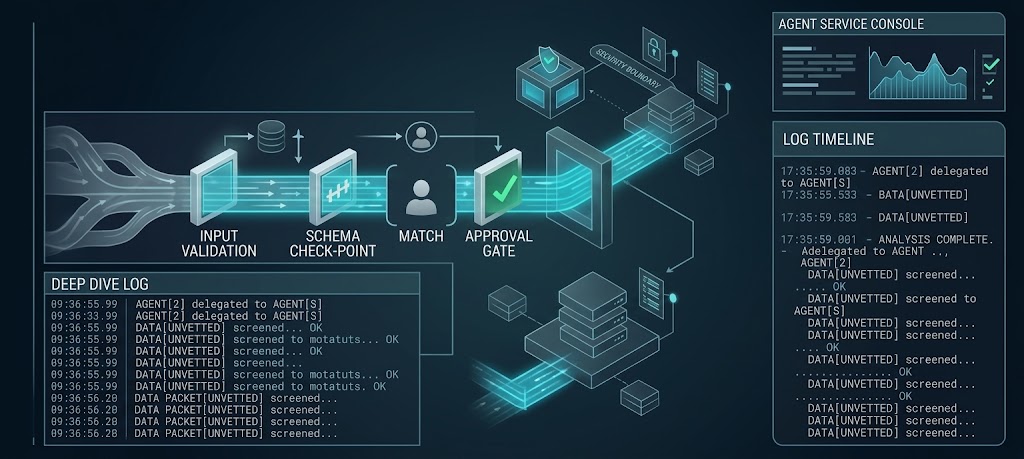
3. Tripartite Perimeter Isolation: Data, Action, and Runtime Environment
Robust enterprise governance requires segmenting security perimeters into three distinct architectural layers, applying specific policy enforcement to each.
Data Boundary Layer
Define what data classifications may enter the model context, what aggregated insights may transition between collaborative agents, and what proprietary data must never leave secure perimeters. A data attribute leaked into the input context window cannot be reliably recovered or recalled through post-generation output screening.
Action Boundary Layer
Categorize system operations into three strict operational tiers: read-only tasks that run autonomously, state-altering operations requiring explicit human approval, and destructive commands that remain blocked globally. A research agent conducting live web search should never inherit the permission sets reserved for administrative ticket management or database modification.
Environment Boundary Layer
Intentionally determine the physical and cloud boundaries where compute happens. Modern cross-platform frameworks allow sensitive operations to remain local on hardened end-user devices, while non-sensitive coordination takes place in scalable cloud clusters. This workload split remains secure only when strict data residency rules govern every inter-tier transaction.
4. Immutable Audit Telemetry and Human-in-the-Loop Approval Gates
Autonomous systems are straightforward to build as prototypes, yet challenging to verify and audit post-incident. The critical distinction lies in the completeness of the audit pipeline. Enterprise architectures must record prompt parameters, tool invocations, source uniform resource locators, delegation paths, approval timestamps, and external payload transmissions. If an autonomous decision pathway cannot be fully reconstructed from immutable logs, the architecture is not production-ready.
In addition to audit logging, implement human verification gates wherever operations alter durable enterprise states. A resilient operational standard establishes that data retrieval and summary generation may occur autonomously, while execution must pass through an authorization checkpoint. The moment an agent requests to edit a enterprise record, modify infrastructure configuration, or transmit outbound notifications, an authorized policy engine or verified user must validate the action.
Enterprise Procurement Checklist: Core Questions for Agent Platform Vendors
Enterprise security teams have long recognized through application firewalls, identity providers, and privileged access suites that the governance control plane outweighs raw functional breadth. When evaluating agent orchestration platforms, technical buyers must scrutinize architectural isolation, multi-tenant partitioning, runtime web ingestion controls, and end-to-end telemetry trails. Platforms backed by concrete governance mechanisms deliver sustainable operational capabilities, whereas platforms lacking these controls expose production environments to compounding systemic risk.
Frequently Asked Questions
Essential security and operational clarifications for infrastructure engineers and procurement leaders scaling autonomous systems.
Establish architectural boundaries before scaling operational capability. Organizations that define permissions, map trust topologies, log telemetry, and gate sensitive actions will deploy autonomous systems with sustainable confidence.
