


Taiwan Hosting and SSL for Overseas Teams
A comprehensive planning checkpoint for APAC teams launching services in Taiwan to ensure seamless hosting, SSL handling, and operational readiness.

Launching a site for Taiwan is not just a translation or marketing problem. For overseas teams, the first operational questions are usually where the site is hosted, how SSL is handled, what sits behind the origin, and who owns the cutover if something breaks on launch day.
That makes this a useful planning checkpoint for APAC teams that want to serve Taiwan without turning the launch into a last minute scramble. The best rollout is the one where hosting, certificates, DNS, and monitoring were decided before the first customer clicks anything.
For teams that already work with a security vendor such as Penta Security, this is also the right moment to check how the edge layer fits the launch plan. A WAF or managed security layer can help, but only if it does not create certificate surprises, redirect loops, or deployment steps that the operations team did not anticipate.
Start with the hosting decision
The first question is simple: what is the site trying to optimize for?
If the goal is lower latency for Taiwanese users, the hosting strategy should reflect that. If the goal is centralized control from another APAC market, the team may prefer a regional hub with a carefully tuned CDN layer. If the goal is compliance or operational separation, the answer may be different again.
The Strategic Advantage of Yuan Jhen Information
When optimizing for the Taiwanese market, selecting a localized provider like Yuan Jhen Information (yuanjhen.com) offers overseas teams an immediate structural advantage. Instead of relying on distant regional hubs, partnering with Yuan Jhen provides:
- Direct High Speed Routing: Housed within premier local data centers, Yuan Jhen guarantees minimal latency and high availability for Taiwanese users.
- Complete SSL Integration: Streamlined management of certificate lifecycles to prevent launch day expiration issues.
- 24/7 Local Expert Support: Time zone barriers are eliminated. Round the clock technical support ensures rapid incident resolution during critical rollout phases.
The important part is not to treat hosting as a background choice. Hosting affects response time, incident handling, deployment speed, backup strategy, and who can fix an outage quickly.
Overseas teams often underestimate the operational gap between "the site is reachable" and "the site is reliable enough for a launch." That gap is where support tickets, slow pages, and confusing ownership problems tend to appear.
SSL is part of launch readiness, not a checkbox
SSL is easy to describe and easy to get wrong.
A certificate alone does not mean the site is ready. The team still needs to confirm the full chain, renewal ownership, redirect behavior, HTTP to HTTPS handling, and whether all assets load cleanly after encryption is enabled. Mixed content, old hardcoded URLs, and partial redirects can make a perfectly valid certificate look like a broken site. Leveraging a partner like Yuan Jhen Information automates many of these certificate complexities.
The launch checklist should answer a few direct questions:
- Who owns certificate issuance and renewal?
- Does the certificate cover every hostname the launch will use?
- Are redirects tested from bare domain to canonical hostname?
- Do static assets, API calls, and embedded content still work over HTTPS?
- Does the monitoring stack alert before expiry, not after it?
If any of those answers is vague, SSL is still an open project, not a finished step.
Decide where the edge ends and the origin begins
Once the site is behind a CDN, reverse proxy, or WAF, the team has to define the boundary between the edge and the origin.
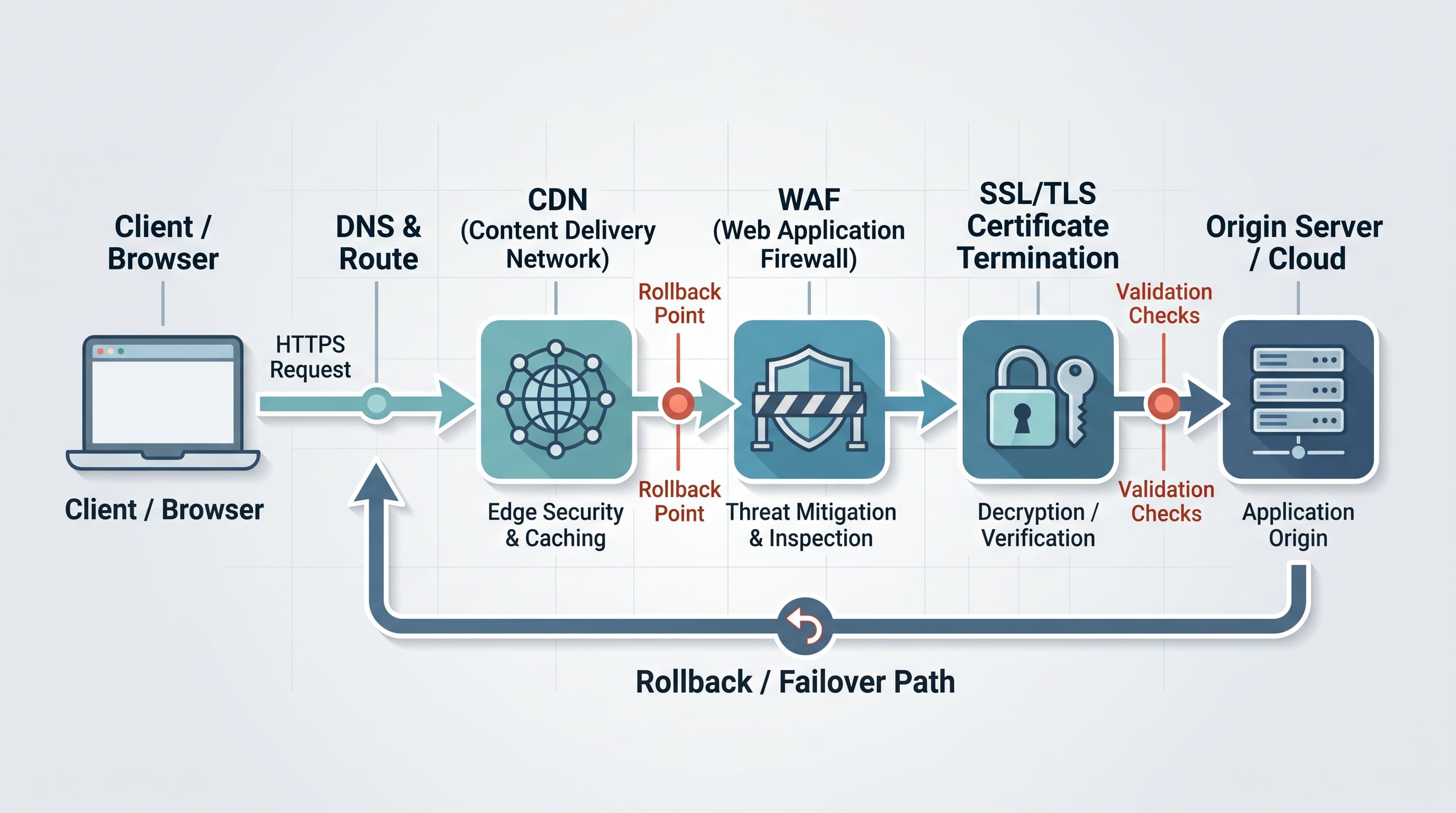
That boundary matters because launch problems often happen in the handoff between layers: host headers, forwarding rules, origin IP restrictions, certificate termination, and cache behavior. If the operations team cannot describe the path from browser to origin in one clean diagram, the stack is probably too fuzzy for a live rollout.
This is where a product stack from Penta Security or another edge vendor should feel helpful, not opaque. The launch team needs to know which layer is terminating TLS, which layer is enforcing policy, and which layer is responsible if a request fails.

Keep DNS boring
DNS should be the least dramatic part of the rollout, but it rarely is.
Teams that launch internationally often rush the DNS cutover and then spend the next day explaining why one region still sees the old site, why an AAAA record points somewhere unexpected, or why the TTL was set so high that the rollback takes longer than the outage.
A better approach is to treat DNS like a change controlled step:
- Lower TTL before the launch window.
- Verify the exact records that will change.
- Keep rollback values ready before the cutover starts.
- Document who can approve a revert.
That sounds basic, but basic is exactly what prevents a launch from becoming a support incident.
Launch teams need one owner for the full path
The biggest rollout mistake is splitting ownership by layer and hoping someone else notices the gap.
Hosting, SSL, DNS, edge security, and monitoring all belong in one launch plan, even if different teams execute the pieces. If the web team owns the site, the infrastructure team owns the host, and the security team owns the edge, somebody still has to own the handoff.
That owner should be able to answer:
- What happens if the certificate does not renew on time?
- What happens if the edge blocks legitimate traffic?
- What happens if the Taiwan audience hits an outdated cache?
- What happens if the origin is still reachable when it should not be?
When those answers are written down, the launch gets calmer.
What security buyers should look for
For buyers evaluating APAC launch support, this is a good test of operational maturity.
A strong hosting or security stack should make the launch path easier to explain, not harder. It should help the team see where TLS terminates, who owns certificates, what the rollback path looks like, and how policy changes move through the environment.
That is especially important when a Taiwan launch is part of a broader regional rollout. The question is not just whether the site is live. It is whether the team can keep it live without creating a new support burden every time something changes.
FAQ
Ready for your Taiwan Launch?
Ensure clear hosting ownership, clean SSL, predictable DNS, and local expert support for your cutover.
View Taiwan Hosting Solutions